

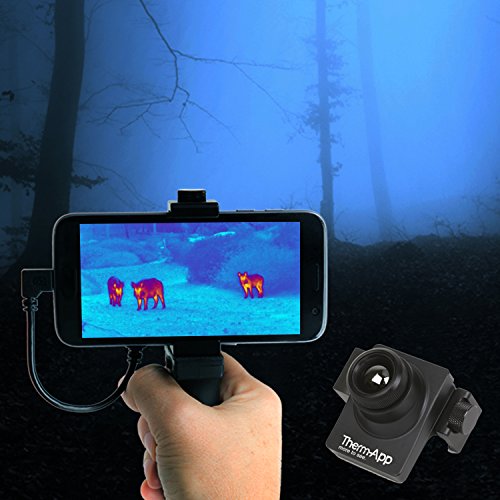
Therm-App is an innovative thermal camera that is small enough to fit in your pocket or the palm of your hands. A product developed by Opgal Optronic Industries, this thermal camera will transform your Android smartphone into a functional high quality thermal camera.
Brief History of Opgal Optronic Industries Ltd.
Opgal Optronic Industries, an Israeli Company, is a leading player in the world of Thermal and near infrared devices. Since 1983, the company has established itself as a reliable brand for security, aviation, industrial, and defense markets.
The Therm-App thermal camera is their most popular product so far. It uses the processing power and display capabilities of your Android smartphone to give you a powerful thermal camera that is great for outdoor and professional thermography.
When it comes to thermal cameras, FLIR is another name we can’t overlook. It is a brand with some of the best thermal cameras for different situations.
Let’s compare features between the Therm-App, FLIR ONE, and SEEK Compact Thermal Cameras.
The FLIR One and Seek Compact thermal cameras are entry-level models that are best suited for home inspections or for outdoor activities like watching animals or finding a lost pet. The Therm-App provides even more possibilities as it can be used in professional thermography. This means they can be of use in detailed inspections and to solve problems such as rescue missions in a burning building.
You get high-end resolution with the Therm-App camera at 384 x 288 pixels over 160 x 120 for the FLIR ONE and 206 x 156 for the FLIR Seek Compact.
The Therm-App also allows changing of the lenses which is an incredible solution to improving versatility for different situations. And with the detailed images, you will be able to achieve more with the Therm-App on a professional level.
However, the Therm-App thermal camera is only compatible with Android devices which is a drawback.
Therm-App Thermal Cameras Review
Therm-App Basic Review

This thermal camera is the most popular in the Therm-App line. It is a professional-grade model with two operating modes. It provides full day and night imaging as well as basic thermography. From inspecting buildings to catching intruders, and tracking animals in the dark, you have every reason to own the Therm-App Basic.
Since it attaches directly to your smartphone, you will be able to transmit images directly from the field. It provides fast feedback so that you can finish a project faster rather than waiting for feedback when you have left the field.

Easy to Use:
This camera can attach to your smartphone using a clip. It is a simple process that does not take long to perfect. You will love its versatility since it can also mount on tripod stands as well as tripod mounts.
When using it with your Android smartphone, you only need to download the Therm-App from Google, and you can start exploring the world of thermal images. Don’t forget to insert the USB cable to your smartphone.

Compatibility:
Therm-App Basic and all other thermal cameras in this line will work with every Android smartphone that runs Android 4.1 or higher and supports USB OTG. This is almost every Samsung Galaxy phone from the A8 to the Samsung galaxy F. It will also work with the LG, HTC, and Motorola smartphones.
Take it Everywhere:
With an IP54 rating, this thermal camera is going to go anywhere you want it to. It can withstand direct water splashes, dust, oil, and dirt. It is ruggedly built to withstand the environment elements which means you can count on it for most adverse situations.
Image Quality and Frame Rate:
This thermal camera will give you crisp, clear images in the dark no matter the weather condition. It uses a 380 x 288 17u thermal detector that is complemented by this unit’s image processing algorithms. This results in well-detailed images.
The Therm-App software comes in handy to give you more imaging as it allows you to record videos with audio or take snapshots. It also has a zoom feature that offers continuous zoom using your phone’s touchscreen.
Looking at the frame rate, this model has a 8.7Hz refresh rate. It is not the best aspect of this device since it will be hazy when watching or tracking moving moving targets. But with the Therm-App Hz, you get a higher refresh rate (25Hz) which translates into better images of moving targets.
PROS:
CONS:
Therm-App Hz Review

There are not many differences between the Therm-App Basic and Therm-App Hz. Well, except for the 25H