

Thermal cameras are important to people who spend most of their time on the water. They provide superior protection in challenging conditions especially in low light scenarios. Flir thermal cameras counter limitations making your trips on the water safer.
But what other benefits do marine FLIR thermal cameras offer? Are they better than radar technology and what are the best applications on the market? These are the topics we’ll be covering in this Flir marine camera review.
Thermal Cameras vs Radar Technology
Both thermal cameras and radar technology have their advantages, limitations & purpose. The best option depends on what you’ll use it for. Let’s go through the features of both of these innovative designs.
Differences in Detection
Radar
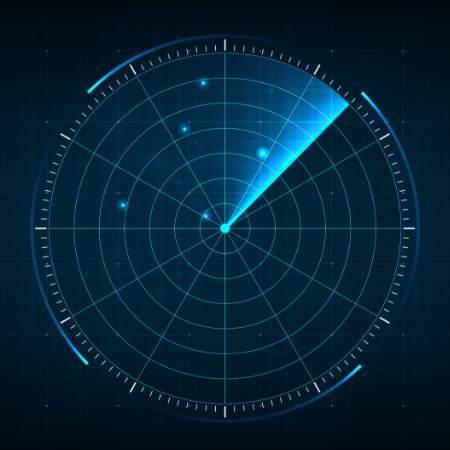
Radar technology detects and displays echoes produced by an object whether it’s land items, rocks, floating debris or boats.
Thermal Cameras
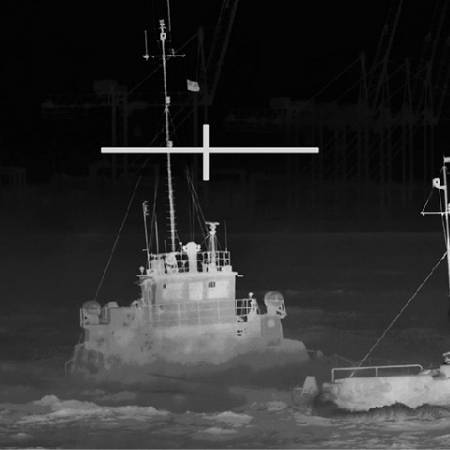
As mentioned before thermal cameras detect heat radiation from objects. But it also detects slight differences in heat as little as 0.01°C and displays them as different colors.
The Range of Radar and Thermal
Radar Range
Typically radar applications can reach distances of 24 to 64 miles and further depending on the model.
Thermal Range
Flir thermal cameras have a shorter range of approximately a quarter mile. Some models have a zoom function that allows the user to zoom in on objects as far as three miles or more.
Direction of Radar and Thermal
Radar Direction
Radar technology has the ability to display a 360° picture of all objects situated around the outside of your boat.
Thermal Direction
Unlike radar, thermal is designed to focus its view in a single direction of interest. When you point the camera in a specific direction it will only use thermal imaging in that specific point of interest.
What is the Difference between Radar and Thermal Cameras?
There are many differences between radar technology and thermal imaging. But combined they will enhance your safety when you’re on your boat. Take a look at these differences between radar and thermal imaging.
Key Features of Radar Technology
- Mounted in place with a fixed antenna
- Built-in Wi-Fi to access the internet
- Measures the bearing and range of moving targets such as other boats
- These devices can track the boat’s speed and course which can prevent collisions
- Radar with integrated GPS systems can be imposed on your chartplotter screen
- GPS and radar create living navigational maps to refer to when traveling
- You have an option of placing a guard zone around your boat which sounds off an alarm when an object is in range of your safe zone
Key Features of Flir thermal Cameras
- Wi-Fi technology
- Comes in different applications such as handheld, mounted and fixed devices
- Flir thermal cameras are used to detect slight differences in heat emitting from objects
- Valuable for water rescue missions
- Flir thermal cameras are ineffective when viewing through the glass as they’re heat barriers
- These devices can be mounted stationary and forward-looking
- The operator has the ability to move the camera around
- Some high-end applications have camera stabilization to steady images in rough seas
- Other applications can be used to select and track moving targets
Advantages of Thermal Cameras
- Detects slight differences in temperatures
- Allows you to view objects in low light
- Has camera stabilization for clearer images
Disadvantages of Thermal Cameras
- Can’t navigate to waypoints
- Doesn’t have the ability to detect coastlines
- Can only detect certain objects depending on the range and thermal temperature operation
Advantages of Radar
- Detects any object around your boat
- It can sound off alarms when there’s a potential threat
- Integrated GPS technology so you won’t get lost
Disadvantages of Radar
- Only detects objects that produce an echo
- Not suitable for navigation at night or in low light conditions
Flir Fixed Mount Marine Thermal Cameras
1. Flir M132

The Flir M132 is a compact adjustable tilt camera that’s the smallest in the FLIR marine range. FLIR’s M132 adjustable tilt offers optimal positioning while you travel on the water.
You can use the integrated ClearCruise intelligent thermal analytics to alert you when non-water objects such as boats appear in your scene.
Product Specs:
The M132 features a resolution of 320 x 240 with a 24°x18° field of view which improves safety as it reveals obstacles and vessels during the night. FLIR’s M132 also features a 4x continuous e-zoom so you can see an object clearly from far away.
With the M132’s adjustable tilt of +110°, -90° it stabilizes the images when you’re moving or adjusting the position of the camera. The dection distance is 1500 feet for a person in the water and .67NM for a small vessel. This Flir thermal camera is ideally suited for boats up to 50ft. in length.
2. Flir M232

Here is another compact fixed mount thermal camera suitable for recreational vessels. If you combine your M232 with Axiom MFD you can use ClearCruise intelligent thermal analytics. This feature provides audible and visual alerts when other vessels or obstacles are in your path.
ClearCruise optimizes your safety on the water during the day or night as it helps you detect any threats in your path.
Product Specs:
The FLIR M232 has a detection range of 1500 ft. for a person in the water and .67NM for a small vessel. The 320x240 thermal resolution will optimize your horizon to horizon viewing. M232’s field of view is 24°x18° which also improves your visual images. It also has a 4X continuous zoom so you can see objects clearly from far away.
FLIR’s M232 thermal camera has a 360° continuous tilt of +110°, -90° to stabilize the device for clear images when you’re traveling on water. The operating temperature range is -13°F to +131°F (-25°C to +55°C) allowing it to be used in almost all conditions where you will operate your boat. The M232 is suited to boats up to 50ft. in length.